
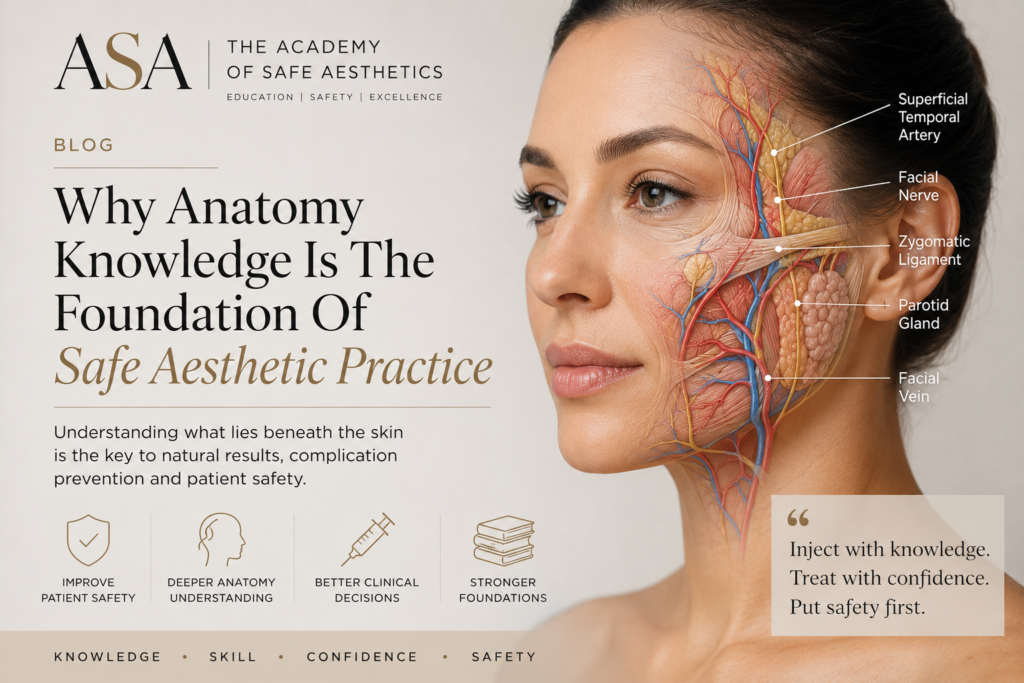
One of the most important differences between an average injector and an exceptional injector is anatomy knowledge.
In aesthetics, every treatment involves working around complex networks of blood vessels, nerves, muscles, fat pads, ligaments, and structural anatomy. A practitioner may technically know how to inject a product, but without a deep understanding of what lies beneath the skin, patient safety can be significantly compromised.
At The Academy of Safe Aesthetics, anatomy forms the foundation of everything we teach because safe aesthetic practice starts long before a syringe ever touches the skin.
Many patients assume aesthetic treatments are simple procedures because they are commonly advertised on social media and performed within clinics, salons, and beauty settings. However, injectable aesthetics remains a medical procedure with real anatomical risks. Areas such as the nose, glabella, temples, forehead, and tear troughs contain important vascular structures that, if accidentally compromised, can lead to serious complications including vascular occlusion, tissue necrosis, and in rare cases, blindness.
Understanding anatomy is therefore not optional. It is a clinical responsibility.
One of the biggest misconceptions among new practitioners is believing that anatomy can be learned superficially through diagrams or memorisation alone. In reality, anatomy within aesthetics is dynamic. Facial anatomy changes between individuals and evolves continuously throughout the ageing process. Factors such as age, weight loss, previous treatments, gender, ethnicity, and genetics all influence facial structure and vascular patterns.
A practitioner who truly understands anatomy does not simply inject into “standard points”. They assess each face individually. They understand depth, danger zones, tissue planes, and how product behaves differently depending on placement and anatomy.
For example, the ageing process itself is far more complex than many people realise. Facial ageing is not caused solely by wrinkles. It involves gradual changes to bone structure, fat compartment distribution, ligament laxity, muscle activity, and skin quality. Without understanding these deeper structural changes, practitioners may over-treat superficial concerns without addressing the true underlying cause.
This is often why inexperienced injectors can unintentionally create unnatural results. Overfilled cheeks, distorted lips, heavy midfaces, and poorly balanced profiles frequently occur when practitioners focus purely on injecting volume rather than understanding facial proportions and anatomical support structures.
Good anatomy knowledge allows practitioners to treat patients more conservatively and more naturally. Rather than chasing trends or overcorrecting individual features, they are able to restore balance while preserving facial identity.
Anatomy also plays a major role in complication prevention. Every injector should understand:
- High-risk vascular areas
- Safe injection depths
- Appropriate product selection
- Cannula versus needle considerations
- Signs of vascular compromise
- Emergency management protocols
Importantly, complication prevention begins before treatment even starts. A strong consultation and facial assessment allow practitioners to identify risk factors such as previous filler migration, scar tissue, vascular fragility, autoimmune conditions, unrealistic expectations, or unsuitable anatomy for certain procedures.
At The Academy of Safe Aesthetics, we emphasise that anatomy education should not stop after foundation training. The best practitioners continue refining their anatomical understanding throughout their entire careers through:
- Advanced anatomy masterclasses
- Cadaver training
- Complication management courses
- Clinical mentorship
- Ongoing practical experience
The aesthetics industry evolves constantly, and continuous education is essential to maintaining safe practice.
Interestingly, patients themselves are also becoming more anatomy-aware. Increasing numbers of patients now actively ask practitioners about qualifications, training, complication protocols, and anatomical knowledge before proceeding with treatment. Trust within aesthetics is shifting away from purely social media marketing and increasingly towards clinical credibility and patient safety.
This change is ultimately positive for the industry. It encourages higher standards, safer practice, and better patient outcomes.
For new practitioners entering aesthetics, anatomy can initially feel overwhelming. However, developing confidence in anatomy takes time and repetition. Strong practitioners are not created overnight. They are developed gradually through study, observation, practical experience, and ongoing mentorship.
At The Academy of Safe Aesthetics, our goal is not simply to teach practitioners how to inject. Our goal is to help practitioners understand why they inject, where they inject, when they should inject, and when they should not.
Because ultimately, aesthetics is not just about creating beautiful results.
It is about creating safe results.
To learn more about our training programmes and mentorship pathways, visit:
Leave a reply












Leave a reply